Accelerating Social Implementation through Software Platform Development

Why is a software platform important?
It's self-evident that for a quantum computer to be called a "computer," it must be provided in a "usable" state. Based on this premise, when we consider the distinction between "hardware" and "software," the key to widespread adoption and the practical application of quantum computing in society lies in defining how software will be applied, what it will be used for, and what value it will create—in other words, defining "use cases."
The "software platform" as defined by Q-STAR serves as an interface that separates the worlds of hardware and software, positioning it as a middleware layer, so to speak.
Research and development in quantum computer hardware is rapidly progressing, with multiple approaches existing, and it is currently uncertain which hardware and implementation technologies will become mainstream. In this situation, to consider software applications without being affected by changes in hardware, we believe a middleware layer is necessary to bridge the gap. Defining this middleware as a "platform" that everyone can use, and accelerating its social implementation, is Q-STAR's fundamental concept for a software platform.
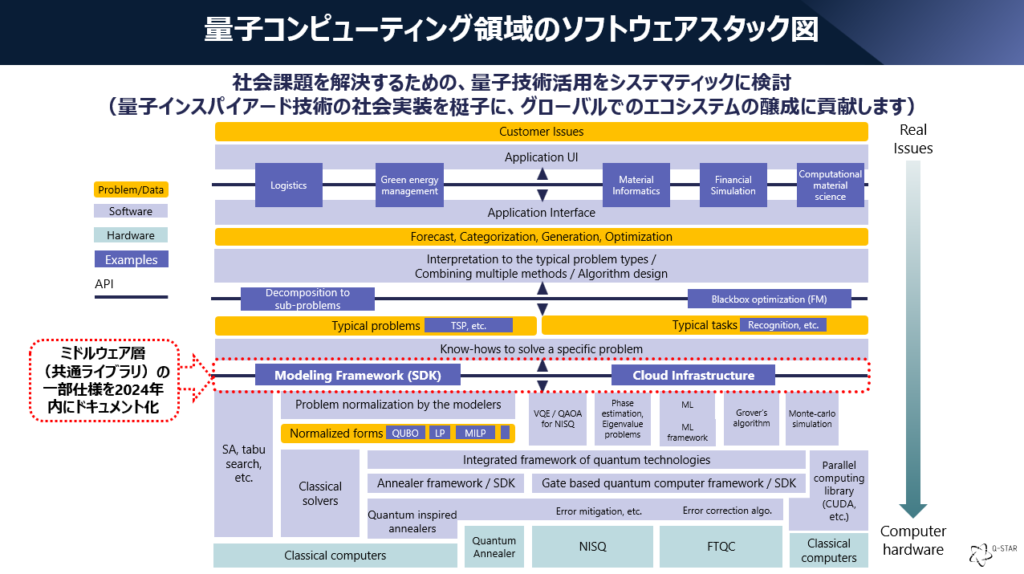
In the field of conventional computer utilization and implementation, complex and multi-layered divisions are defined between hardware and application software. While such distinctions are not yet clear in quantum computing, we believe a similar approach will eventually be applied.
Realization and Definition of the Software Platform at Q-STAR
In the current nascent stage of the market, by drawing a line between hardware and software and fundamentally adopting the idea of introducing a platform—that is, middleware—we are promoting the development of an environment that allows for the exploration of usable use cases without being dependent on hardware advancements.
As for the hardware to actually run, Ising machines and quantum-inspired machines that can be used for immediate demonstration are necessary. What's important here is that even as hardware evolves, applications can be developed to be somewhat common, and their usage methods can be anticipated. To test use cases that can run on existing hardware and connect them to practical business applications, platforms and middleware are indispensable.
There's a sense of crisis that technology will decline if we merely wait for hardware to advance, so we need to consider concrete use cases. Furthermore, it's important not just to consider things theoretically but also to get hands-on. For this reason, we are collaborating with various working groups on initiatives such as developing testbeds for user company trials and efforts aimed at standardizing middleware specifications.
In Japan, due to historical circumstances, we have been proactively working with Ising machines that leverage existing computing technologies. When introducing Ising machines overseas, their differences might be complex and difficult to understand. Therefore, middleware is expected to play a role in making the technology of Ising machines easier to comprehend. A key feature of the middleware developed by Q-STAR is that it can be used with machines from any vendor.
Overseas, there are few software manufacturers engaged in the development and provision of Ising machines, and our impression is that there isn't much thought given to developing middleware for them in the first place. In this regard, we believe there is an opportunity to spread Japanese technology to customers worldwide.
Practical Initiatives for Realizing a Software Platform
Activities related to examining the implementation level of the platform and promoting its use are being advanced primarily by the Combinatorial Optimization Working Group within Q-STAR. Combinatorial optimization problems have been "rediscovered" in recent years due to their potential for resolution by quantum computers. While some experts suggest that "one could solve combinatorial optimization problems by devising their own algorithms even without using an Ising machine," we believe that introducing middleware and software will make the technology more accessible to non-expert programmers, thereby further expanding its range of applications.
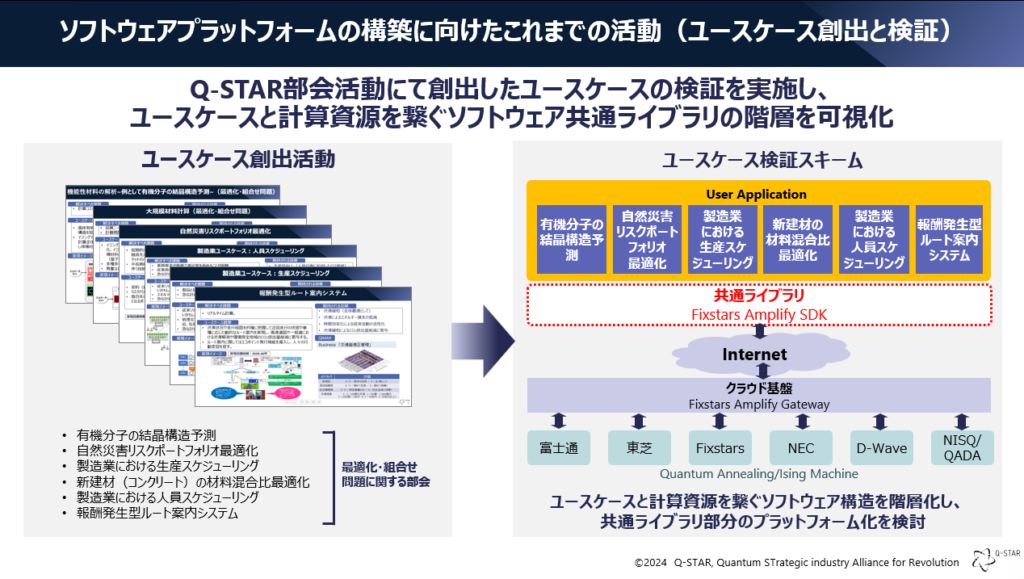
The common platform that Q-STAR aims to provide and the SDK offered by member company Fixstars Amplify Inc. are one and the same. With the SDK, even general programmers can easily write and solve algorithms for combinatorial optimization problems. It is necessary to provide tools like the SDK that play an educational role in promoting the "rediscovery" of combinatorial optimization problems and are convenient to use even without specialized knowledge. This will enable the application of combinatorial optimization problems in various fields even before the practical use of quantum computers, creating business opportunities and generating profits.
Regarding International Collaboration on Software Platforms
Efforts are underway to exchange memoranda of understanding with various private quantum-related organizations and to foster close collaboration. Specifically, we are beginning to explore what kinds of public-private collaborations are possible with organizations such as the U.S. QED-C and Europe's QuIC, as well as with AIST (National Institute of Advanced Industrial Science and Technology) and its international research institution counterparts. We are sharing Q-STAR's ideas regarding software platforms and calling for participation in use case exploration.
This initiative is important in two ways. First, it allows us to showcase Japan's strengths in Ising machines and the results of our use case exploration. Second, it's about expanding our business by enabling people overseas to utilize Japanese technology. There may be latent demand for Ising machines abroad, and the inherent potential of combinatorial optimization problems is universal. We hope that this perspective will lead to a rediscovery of the importance of combinatorial optimization problems, and by providing a useful common platform for problem-solving, it will create opportunities for companies to expand their business within a global ecosystem.
Currently, many user companies in this field are primarily gathering information. However, the advancement of use cases and hardware won't happen by simply waiting; they progress through mutual stimulation. A new computing paradigm is on the verge of emerging, yet no one has fully understood or discovered what next-generation computing will truly look like.
In this environment, Q-STAR aims to engage in activities with its member companies with a spirit of "co-creation," enjoying the process. We will propose ideas such as "it would be great if we could use it this way," and while promoting adoption among user companies, we will also strive to provide new insights for developers on the vendor side.
Related Links
Software Platform Fixstars Amplify – Quantum Computing Cloud