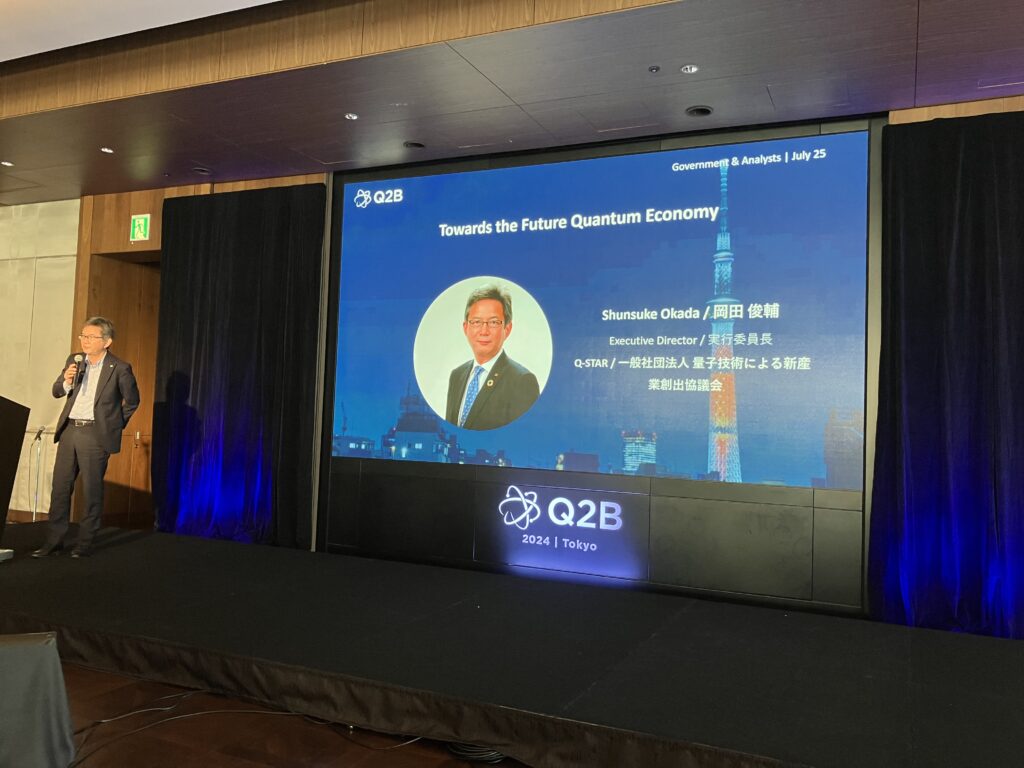
Q-STAR Executive Committee Chairman Mr. Okada speaks at “Q2B24 Tokyo – Towards Quantum Computing”
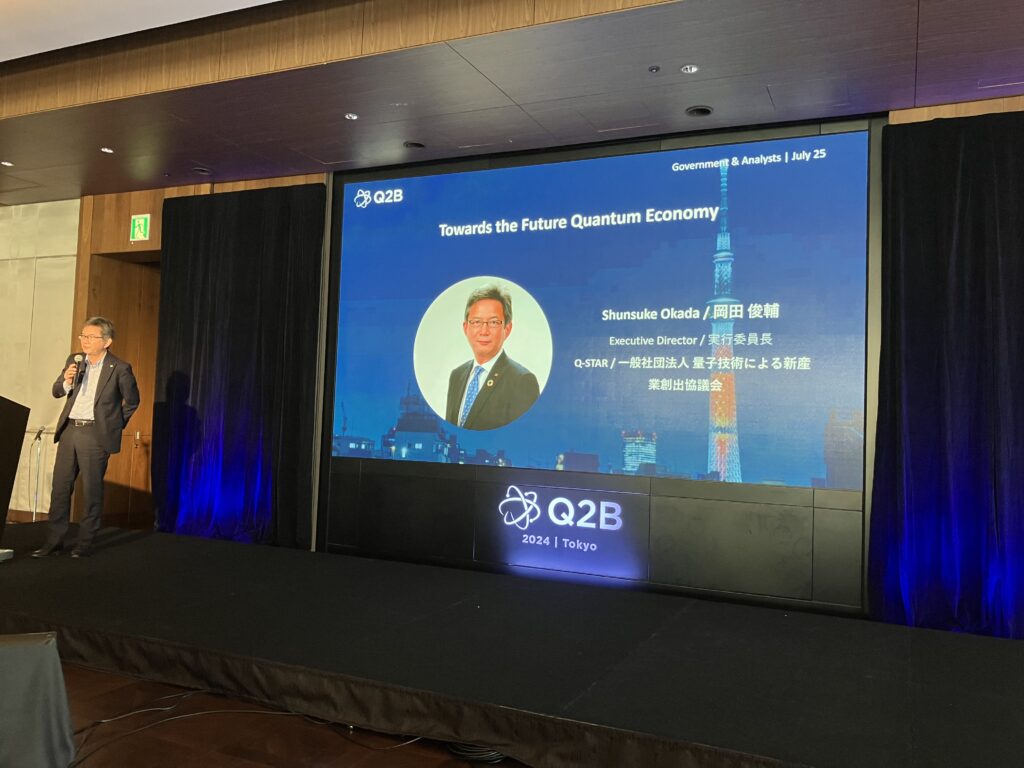
Q-STAR Executive Director Okada spoke at "Q2B24 Tokyo ~Towards the Realization of Quantum Computing~".
[Date & Time] Wednesday, July 24, 2024 – Thursday, July 25, 2024
[Venue] Grand Hyatt Tokyo
[Organizer] QCWARE
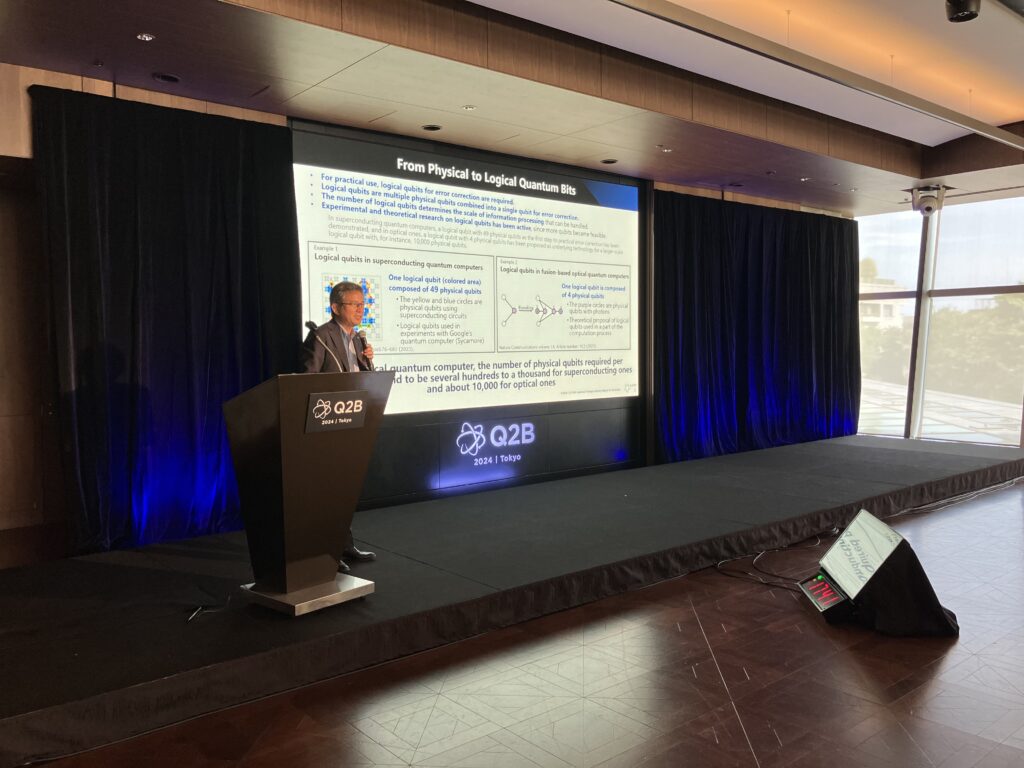
Q-STAR Executive Director Okada's Lecture Summary (Afternoon of 25th)
About Q-STAR
Q-STAR is an organization dedicated to fostering industries in quantum technology. Covering a broad spectrum of fields including quantum computing, sensing, materials, and communications, our goal is to "realize a society where 10 million people are unknowingly utilizing quantum technology by 2030." A distinctive feature of Q-STAR is that user companies comprise over half of our membership, not just vendors, fostering vibrant discussions from a user perspective. This user-led approach to discussions is a rare initiative globally. Q-STAR also actively supports startups, with 17 companies currently participating as associate corporate members, a number expected to grow.
Q-STAR's daily operations are managed by the Executive Committee, which focuses on communication with international organizations, standardization, intellectual property, and public relations. We have established subcommittees for each category of quantum technology to discuss various use cases. Moving beyond theoretical discussions, we collaborate with G-QuAT to conduct concrete demonstrations in real-world environments, providing information on how to leverage quantum technology both domestically and internationally. In May of this year, we established the "SDGs Promotion Subcommittee through Quantum Technology." We will actively share insights on how quantum technology can address global challenges.
Various technologies are employed in quantum computing and related fields. Among these, the Ising model is a particular strength of Japan. A unique characteristic of Japan is that Japanese companies are providing engines to simulate quantum states on existing computers, leading to the initial resolution of societal challenges. Q-STAR believes that even as current simulators are gradually replaced by quantum computers in the future, Japan's proven track record of rapidly solving problems using simulators, and the insights gained from this, will provide a significant international competitive advantage.
Deepening Domestic and International Cooperation
We are also deepening our collaboration with G-QuAT for the social implementation of quantum technology, and the signing of a joint research agreement marks a crucial milestone. A key factor behind this agreement was the recognition of the quantum category and the allocation of a budget under the Cabinet Office's SIP Phase III. We are currently planning initiatives such as demonstrating use cases, developing and implementing educational programs, and building an ecosystem to support startup growth and market entry.
Furthermore, Q-STAR is also committed to globalization. While it can be challenging for the many quantum-related companies to maintain continuous global communication, our daily activities affirm Q-STAR's role as a powerful hub.
Last year, on January 31st, four organizations—QED-C (USA), QIC (Canada), QuIC (Europe), and Q-STAR—launched ICQIA. Its objective is to advance the quantum ecosystem and enhance global communication and collaboration. ICQIA's most significant achievement is the development of a supply chain map. By defining the development activities and technologies possessed by quantum-related organizations in each country, identifying which areas of quantum technology they pertain to, and how they are being utilized, and then integrating this information into the supply chain map, we have established a framework for international collaboration. This supply chain map serves as a global standard for dialogue, fostering deeper international cooperation and accelerating industrialization.
Japan's Contribution to Building a Global Ecosystem
Currently, various quantum computer architectures are emerging, but it remains unclear which will become mainstream. Q-STAR has therefore focused on the necessity of a software platform compatible with all types of quantum computers and has been earnestly discussing its realization over the past year. Our goal is to implement this platform with G-QuAT, creating an accessible environment for everyone.
Q-STAR has also conducted a review of the quantum computer software stack diagram. The middleware layer, central to this diagram, is designed to organize problems and provide solutions tailored to the specific quantum computer architecture. We are currently focused on documenting these specifications.
Japan is a global leader in the field of Ising machines, with numerous examples of solving real-world problems. Q-STAR will showcase to the world the problem-solving capabilities of Ising machines, a Japanese strength, while promoting the establishment of a global ecosystem and fostering the industrialization of quantum technology. Moving forward, we will accelerate initiatives that leverage Japan's strengths and unique contributions towards realizing a quantum society.