
Categories of Quantum Computing and Related Technologies
April 17, 2024
What is a Quantum Computer?
First, let's clarify "what a quantum computer is." A quantum computer is a computer that performs calculations by applying the principles of quantum mechanics. Conventional computers (classical computers) operate using digital circuits with "bits (classical bits)" as the smallest unit of data. A single bit represents either a 0 or a 1. In contrast, quantum computers use "quantum bits" (qubits) as their basic unit. Qubits possess a peculiar characteristic called "superposition," where a bit can exist as both 0 and 1 simultaneously. This property allows quantum computers to represent multiple states at once, enabling high-speed parallel computation and is expected to process complex calculations in a short time, which conventional computers could not achieve.
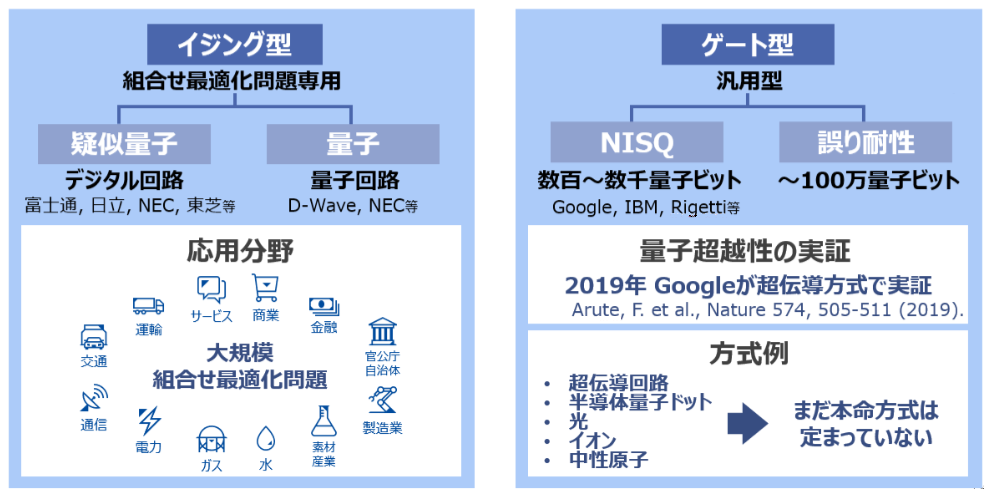
Quantum computing technologies can be categorized into Ising-type (annealing-type) and gate-type, based on their operational principles.
【Ising-Type (Annealing-Type)】
This type performs processing using "quantum annealing," a quantum algorithm specialized for combinatorial optimization problems. While it lacks the versatility of gate-type computers, it can achieve calculations more simply than gate-type, and its application in actual business is already progressing.
【Gate-Type】
This type performs calculations using electronic circuits called "quantum gates." Various implementation methods have been proposed, including superconducting circuits, semiconductor quantum dots, light, ions, and cold atoms (neutral atoms). While it offers general-purpose computation and is expected to have applications in all fields, such as optimization calculations, prime factorization, and chemical simulations, it has not yet reached a practical level for business application.
What is Quantum-Inspired Technology?
While Ising-type (annealing-type) technology is being increasingly used in practical applications, methods have been developed to process complex calculations at high speed on conventional computers (classical computers) by mimicking the computational principles of the Ising model using existing digital circuit technology. This is called "quantum-inspired" technology (also referred to as "pseudo-quantum," "Ising machine," or "annealer"). Since quantum-inspired technology simulates quantum computers, it is not a "quantum computer" in the strict sense, but rather falls under the broader category of "quantum computing technology." It is important to note this distinction, as confusing the two can easily lead to significant misunderstandings about the timeline for practical implementation. Although these are large-scale systems, they operate on standard semiconductor-based computers, so no special hardware for handling qubits is required. Japan holds a strong position in the implementation of quantum-inspired technology.
Current Status and Application of Quantum Computing Technology Development
As mentioned earlier, quantum computers are divided into gate-type and Ising-type (annealing-type). Both apply the principles of quantum mechanics, but their computational methods differ.
Gate-type computers are capable of general-purpose calculations but are susceptible to external noise and lack error tolerance. Consequently, there is debate, with some suggesting practical implementation could take decades, while others believe it might be achievable by 2030. On the other hand, Ising-type (annealing-type) computers are already being applied in business and can be used immediately to solve operational challenges. Furthermore, with pseudo-quantum technology, specialized calculations for combinatorial optimization problems can be performed on conventional computers without the need for special hardware.
One specific application area for Ising-type (annealing-type) technology is transportation and logistics. By searching for the optimal logistics routes among numerous options, it is expected to improve delivery efficiency, reduce costs, and help address "Japan's 2024 logistics problem." Practical applications in other fields such as materials development, drug discovery, manufacturing, and finance are also gaining attention.
Accelerating Social Implementation for the Quantum Computer Era
A combinatorial optimization problem is one that seeks the best combination as a solution from a vast number of options, subject to various constraints.
In a rapidly changing business environment, making quick decisions is essential. Currently, companies are undergoing digital transformation (DX) using digital technologies like AI and IoT, making data from all corporate activities visible. Quantum computing technology comes into play precisely when you want to derive optimal solutions from a vast number of options, based on collected data, for example, to optimize production plans, logistics operations, or considering complex constraints. In particular, Ising-type (annealing-type) computers are already commercialized, and quantum-inspired technology, in particular, is a method in which Japan excels and can be applied to business operations immediately. It is crucial to actively use this technology for all kinds of challenges, from complex to everyday ones, and to start implementing it.
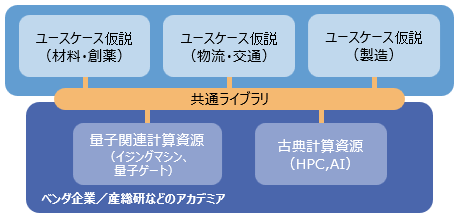
To prepare for the quantum computing era, Q-STAR is actively working daily to create practical and wide-ranging use cases and drive industrialization. We achieve this by combining quantum-inspired technology, one of Japan's strengths, with various existing technologies, such as increasingly relevant AI (machine learning).
Q-STAR Member Companies: Quantum-Inspired Technologies and Services
・Toshiba SQBM+
https://www.global.toshiba/jp/products-solutions/ai-iot/sbm.html
・NEC Vector Annealing Service
https://jpn.nec.com/nec-vector-annealing-service/index.html
・Hitachi CMOS Annealing
https://www.hitachi.co.jp/products/it/finance/solutions/application/common/CMOS-annealing_cloud/index.html
・Fujitsu Digital Annealer
https://www.fujitsu.com/jp/digitalannealer/
・Fixstars Amplify
https://amplify.fixstars.com/ja/