
Quantum Computer Hardware
May 14, 2025

The development of quantum computers is accelerating worldwide, with various implementation methods evolving through both competition and collaboration. A review of the main implementation methods, their characteristics, and current development status reveals two particularly noteworthy trends: technological innovation is progressing faster than previously predicted, and industrial interest in the social implementation of quantum technology is growing. In Japan, national projects, primarily centered on the Moonshot Research and Development Program, are advancing, with R&D leveraging Japan's unique strengths in the global quantum technology race.
Overview of Quantum Computer Implementation Methods
Quantum computer implementation methods are broadly categorized into two types: "quantum gate models" and "quantum annealing models."
The quantum gate model performs computations by applying operations called quantum gates to quantum bits (qubits). This method aims to realize a "universal quantum computer" theoretically capable of addressing any computational problem. In contrast, the quantum annealing model is specialized for solving optimization problems, formulating them as "energy minimization problems" and searching for solutions using quantum tunneling effects.
This time, we will focus on the quantum gate model, which encompasses multiple implementation methods.
Characteristics of Each Implementation Method and the Forefront of Development
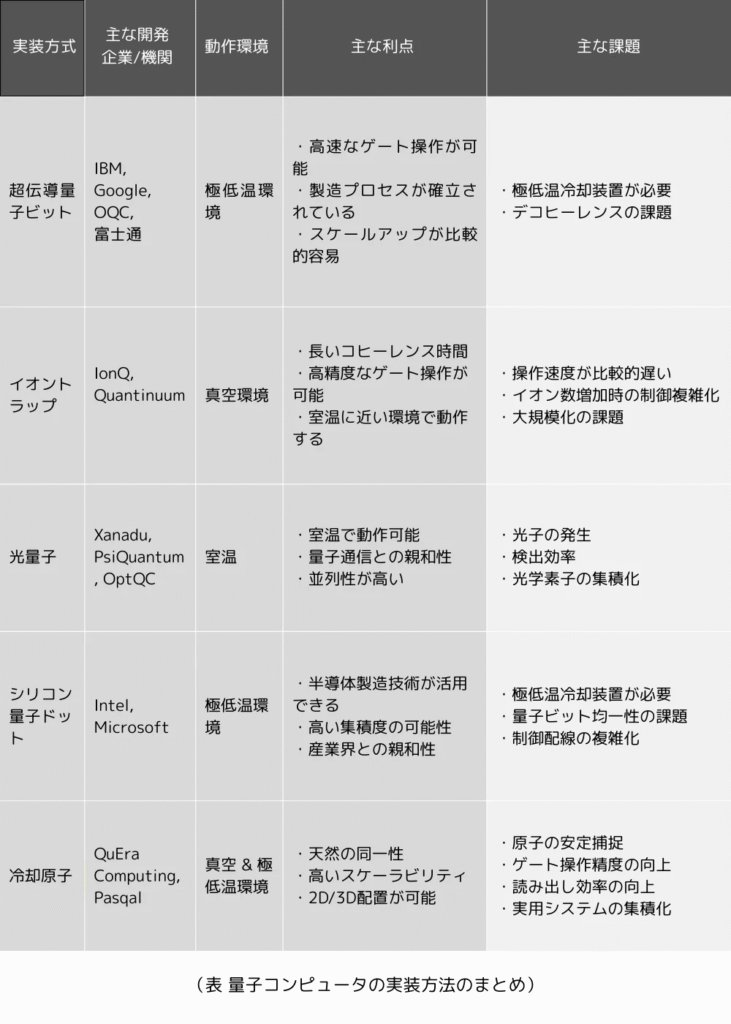
Quantum computer implementation methods for the quantum gate model can be classified by the physical system used. Key methods include superconducting qubits, ion traps, photonic quantum systems, silicon quantum dots, and cold atoms. Each method has its unique advantages and challenges.
The superconducting qubit method utilizes electrons confined in superconducting circuits as qubits. Adopted by companies like IBM, Google, and OQC (Oxford Quantum Circuits), it offers the advantage of high-speed quantum gate operations but presents an infrastructural challenge due to the requirement for an extremely low-temperature environment. In Japan, a computer developed by Fujitsu is operational at RIKEN.
The ion trap method captures ions in an electromagnetic field and uses them as qubits. Companies like IonQ and Quantinuum are advancing its development. While it offers the advantage of maintaining quantum coherence for relatively long periods, manipulating ions requires an extremely low-temperature environment achieved through laser cooling. In Japan, a group centered at Osaka University is conducting fundamental research on the ion trap method and is working on developing technology to maintain long-duration coherence.
The photonic quantum method utilizes the quantum states of photons, capable of operating at room temperature and offering excellent scalability. Xanadu, PsiQuantum, and OrigenQ are driving its development, drawing particular attention for its high integration potential with quantum communication. In Japan, OptQC and NTT are also advancing R&D in this field. Research and development are progressing with an eye toward collaboration with efforts to commercialize quantum communication technologies such as Quantum Key Distribution (QKD).
The silicon quantum dot method is characterized by its high compatibility with existing semiconductor manufacturing processes, as it is based on semiconductor technology. Intel and Microsoft are among those advancing its development, with high scalability expected. In Japan, a joint research team at RIKEN has successfully achieved high-precision quantum operations using silicon quantum dots.
The cold atom method utilizes neutral atoms, trapped and cooled by laser light, as qubits. QuEra Computing, Pasqal, and Atom Computing are driving its development. A major feature of this method is that all qubits are intrinsically identical because it uses naturally occurring identical atoms (primarily rubidium or cesium). This minimizes errors due to manufacturing variations and enables high uniformity.
Each of these methods has its pros and cons. Rather than one method ultimately prevailing, it is highly probable that multiple methods will coexist, depending on their applications and objectives. Indeed, major cloud providers have begun offering access to quantum computers based on various methods.
Business Opportunities in Related Industries Supporting Quantum Computing
While companies in Europe, the US, and China are leading in the commercialization and market introduction of quantum computers themselves, Japan possesses unique strengths when considering the entire value chain of this new industry. There are numerous areas where Japanese companies can demonstrate competitiveness, not only in quantum computers themselves but also in peripheral technologies and related industries that support their operating environments and user applications.
For example, NTT is conducting world-leading R&D in quantum cryptography and photonic quantum technology. In 2022, they successfully demonstrated a new photonic quantum technology using quantum entanglement, establishing a crucial technological foundation for building a future quantum internet. Toshiba is also a global leader in the development of Quantum Key Distribution (QKD) technology, having achieved the world's longest quantum communication over 600km in 2021. Furthermore, efforts toward practical application are progressing, with Toshiba steadily building a track record in quantum security, including the launch of commercial operation of a quantum cryptography network for financial institutions in London in 2023.
Furthermore, semiconductor manufacturing equipment makers, including Tokyo Electron, possess ultra-precision processing technology essential for quantum chip fabrication. Particularly for superconducting qubits and silicon quantum dot methods, nano-level precision processing is indispensable, and the technological capabilities of Japanese companies in this field are highly regarded internationally.
The "Moonshot Research and Development Program," led by the Ministry of Education, Culture, Sports, Science and Technology, aims to "realize fault-tolerant universal quantum computers that will dramatically advance the economy, industry, and national security by 2050." National-level R&D support is also being strengthened. Given that technological development is progressing faster than initially predicted, achieving this goal ahead of schedule is also anticipated.
Building an Ecosystem to Promote Industrial Application
To promote the industrial application of quantum technology, it is essential to build an ecosystem that bridges the gap between technological development (hardware) and business application (business). Globally, this bridging role is recognized as a critical challenge in the social implementation of quantum technology.
Advanced technologies, especially quantum computing, present a significant knowledge gap between developers and users. To bridge this gap, it is essential to foster dialogue between both parties and create an environment where technology development and applied research can progress in line with actual business needs.
In this context, Q-STAR serves as a platform to promote the industrial application of quantum technology in Japan, bridging industry, academia, and government. Specifically, by providing a forum where quantum technology providers and users can gather and discuss, it enables the development of use cases and technology evaluations tailored to practical business operations. Furthermore, Q-STAR is building collaborative relationships with international quantum technology communities, and will continue to explore global technological trends and seek international cooperation that leverages Japan's strengths.
Within the quantum technology ecosystem, a comprehensive approach is essential, encompassing not only hardware development but also algorithm development, software development, application development, and human resource development. Leveraging Japan's strengths in precision manufacturing technology, materials science, and system integration capabilities, it is expected to accelerate the social implementation of quantum technology.