Building a foundation for new industries and solving social issues through quantum technology
Creating new industries and developing solutions for societal challenges
Following the digital revolution (DX1.0) that brought us the smartphones and computers we use daily, and the digital revolution (DX2.0) where physical objects and cyber systems connect, the movement towards Quantum Transformation (QX) is now emerging. Quantum technology possesses immense power to fundamentally change foundational technologies and bring new innovations to industries.
For example, quantum computing is expected to have much faster computational power than conventional computers, enabling the resolution of complex problems in a short time. Furthermore, quantum communication is attracting attention as a technology that enables more secure data transmission, and quantum sensing as a technology that allows for high-precision measurements.
Q-STAR was established with the aim of creating new industries through quantum technology, ushering in this era of QX. Quantum technology is expected to bring innovation across various industries, such as the development of new treatments in healthcare, the realization of more secure transaction systems in finance, and the optimization of route searching in logistics.
However, not all aspects of the technology are yet established. To achieve these, it is essential to rapidly and appropriately integrate usable technologies into industries and to gather cutting-edge information and technologies across all sectors. To play a part in this, Q-STAR has started by organizing discussions as a first step, and has developed a framework that can serve as a guideline for "what needs to be organized" during these discussions.
"QRAMI": A Framework Bridging Quantum Technology and Business
That framework is "QRAMI (Quantum Roadmap Architecture and Management Initiative)".
QRAMI is a reference architecture uniquely structured by Q-STAR, inspired by "RAMI4.0," the standardized framework for realizing Industry 4.0, to meet the specific requirements of quantum technology.
Quantum technology is evolving daily, and its applications are diverse. However, the rapid pace of technological advancement makes it difficult to grasp the overall picture for social implementation, leading to concerns about misunderstandings among stakeholders and inefficient development. Therefore, QRAMI was developed as a tool to provide an overarching view and foster common understanding among stakeholders, thereby facilitating the smooth industrialization of quantum technology.

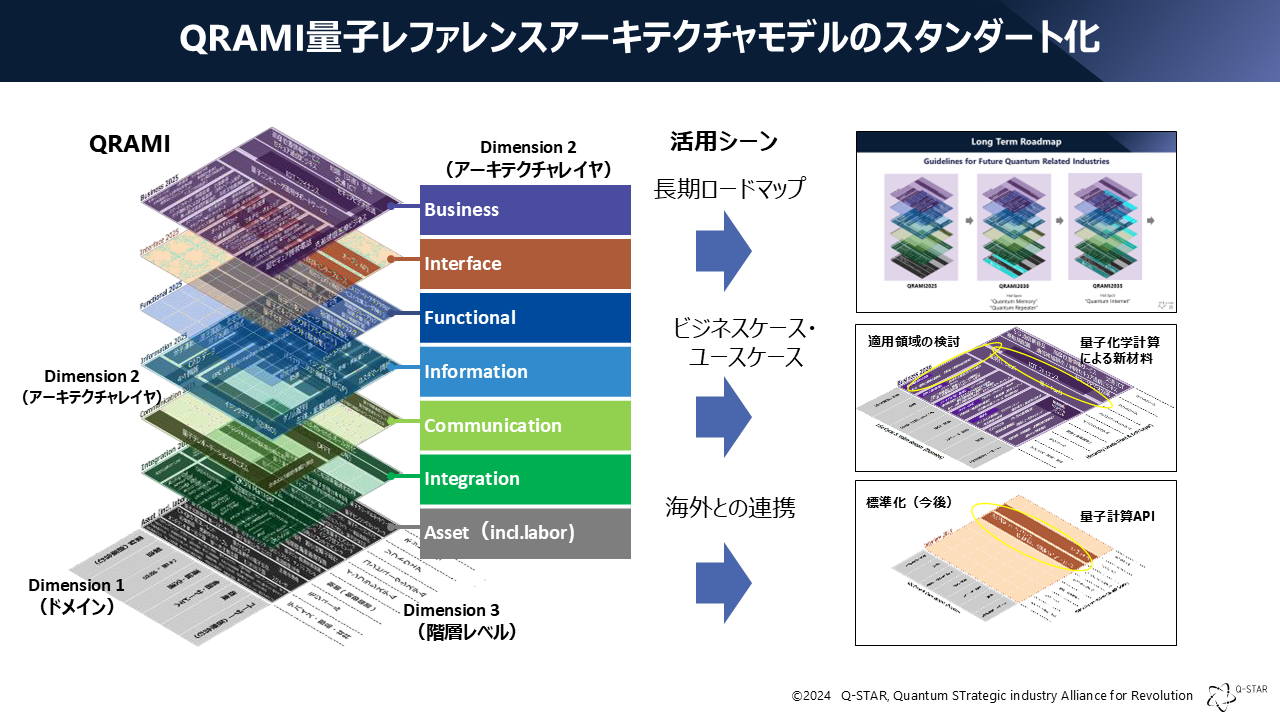
QRAMI is designed with a value chain on the vertical axis and technology layers on the horizontal axis, allowing quantum technology-based businesses to be hierarchically broken down and visualized into seven layers, from business operations to specific technological elements.
Therefore, it can be used not only to establish a common understanding during discussions regarding "what needs to be organized" and "which part of the discussion we are currently on," but also to clarify strengths, weaknesses, and potential collaborations by mapping the initiatives of specific companies and research institutions onto QRAMI.
QRAMI is expected not only to promote technological development for the practical application of quantum technology but also to foster a common understanding across industries and serve as a foundation for building a new ecosystem.
Utilization of QRAMI in Industry
For example, QRAMI can be utilized in business development in the following scenarios:
・Business/Use Case Development: By considering the architecture with reference to QRAMI and then moving on to specific considerations after separating the layers, various discussions can proceed smoothly.
・Roadmap Sharing: It is also used as a tool for sharing roadmaps among stakeholders.
・Standardization: By establishing standards for input/output between layers and standardizing them, we can expect increased efficiency as technology advances.
For example, in the development of a drone operation control system, we concretize the elements in each layer by applying them to QRAMI. This includes defining the business model for service provision (business layer), necessary functions, and required information transmission (function and information layers). Sharing this among stakeholders helps eliminate misunderstandings and ensures smooth development.
Efforts toward the industrialization of quantum technology are still in their nascent stages, and we believe that effective ways to utilize QRAMI as a tool will be discovered as it is put into practice.
Moving forward, we aim to accumulate and progressively incorporate know-how on QRAMI's use in various situations, thereby making it an even more practical framework.