
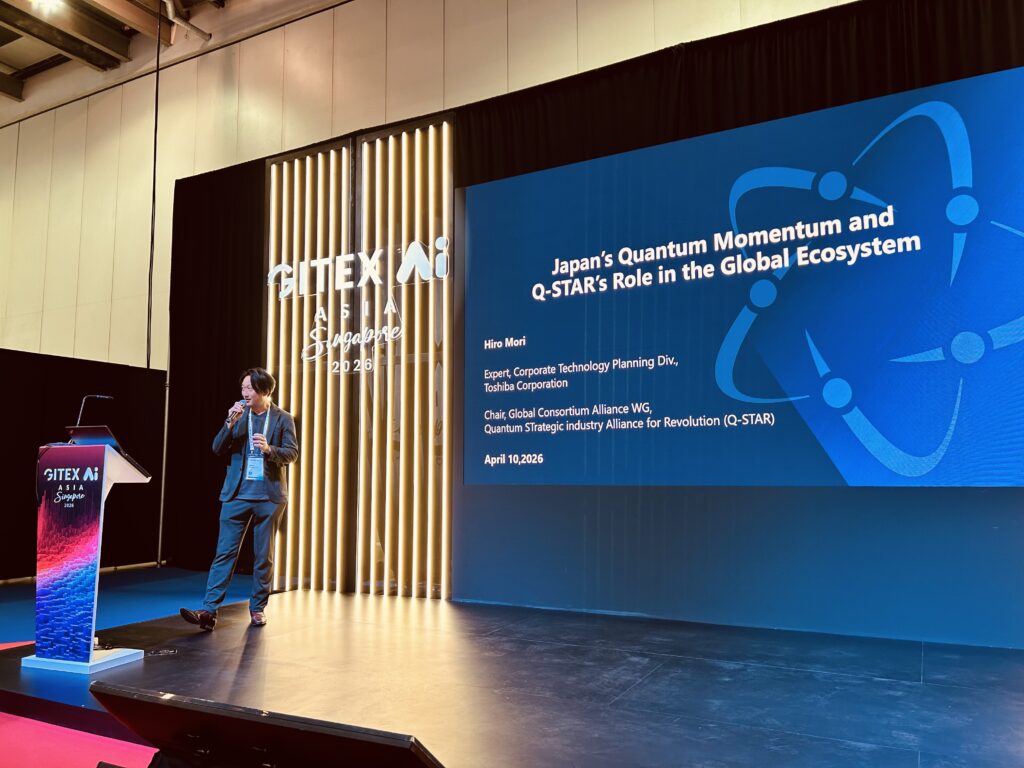
SINGAPORE – April 10, 2026. At GITEX Asia 2026, the message from Japan was clear: the quantum future isn’t just coming; it’s being built, component by component. Hiro Mori, Chair of the Global Consortium Alliances Working Group at Q-STAR (Quantum STrategic industry Alliance for Revolution), delivered a keynote that moved beyond theoretical physics into the realm of industrial reality.
At GITEX Asia 2026, the message from Japan was clear: the quantum future isn’t just coming; it’s being built, component by component. Hiro Mori, Chair of the Global Consortium Alliances Working Group at Q-STAR (Quantum STrategic industry Alliance for Revolution), delivered a keynote that moved beyond theoretical physics into the realm of industrial reality.
Since its inception in 2021, Q-STAR has grown into an ecosystem of 156 organizations. Their mission is bold: a “Quantum-Powered Society” where these technologies are accessible to everyone. By 2030, Q-STAR aims to have 10 million people in Japan actively engaging with quantum systems through a massive push for human resource development and startup acceleration.
Beyond cultivating talent, creating robust technology testbeds is critical. To bridge the gap between lab experiments and commercial products, Mori detailed a strategic joint research agreement with G-QuAT. This partnership maps a pragmatic evolution for the industry, highlighted by milestones like the Tokyo QKD Network. Spanning 90 km, this quantum cryptography testbed is more than a technical achievement; it is an open platform where industry, government, and academia are currently stress-testing the future of secure communication.
Japan isn’t just building the hardware; it is writing the rulebook. Mori highlighted Q-STAR’s pivotal role as Japan’s National Mirror Committee for IEC/ISO JTC 3, leading the charge in international quantum standardization. From contributing to G7 high-level discussions to partnering with Tohoku University, the alliance ensures that Japan’s technical breakthroughs translate into global policy.
Perhaps Japan’s most formidable advantage lies in its specialized manufacturing DNA. While the world focuses on the “brain” of the quantum computer, Japanese industry provides the “nervous system.” Mori emphasized their dominance in critical components and precision control equipment required to operate at temperatures near absolute zero.
Mori closed by reinforcing Q-STAR’s commitment to international collaboration, working alongside partners in the U.S., Canada, and Europe. With recent MoUs signed with UKQuantum and Denmark’s NQCP, Q-STAR is positioning itself as a vital link in the global quantum supply chain.
In just five years, Q-STAR has evolved from a small group of visionaries into a global powerhouse. As they move toward 2030, the alliance is proving that the “Quantum Leap” is less about a single jump and more about the steady, strategic engineering of a new industrial era.